
There is a pattern that shows up consistently in grassroots youth football training. The session begins with a warm-up, moves into a technical drill, perhaps two, and then finishes with a small-sided game in the last ten to fifteen minutes. The game is treated as the reward. The drills are treated as the work.
That structure has it backwards. The small-sided game is not the reward at the end of training. It is the most powerful development tool available to a youth football coach, and in most grassroots sessions it receives the least time, the least design and the least coaching attention of any part of the session.
The research on small-sided games in youth football development is consistent and compelling. Players in small-sided game environments get significantly more touches of the ball per minute than in full-sided games or isolated drills. They make more decisions per minute. They experience more of the game's fundamental challenges, receiving under pressure, choosing when to pass and when to drive forward, defending in tight spaces, transitioning between attack and defence, in a shorter period of time than any other training format produces.
The reason is structural. When you reduce the number of players on a smaller pitch, every player is involved more frequently. There is nowhere to hide. The ball comes to every player more often. The decisions come faster. The physical demands are proportional to the size of the game rather than the demands of an eleven-a-side match that most junior players are not yet physically or cognitively ready for.
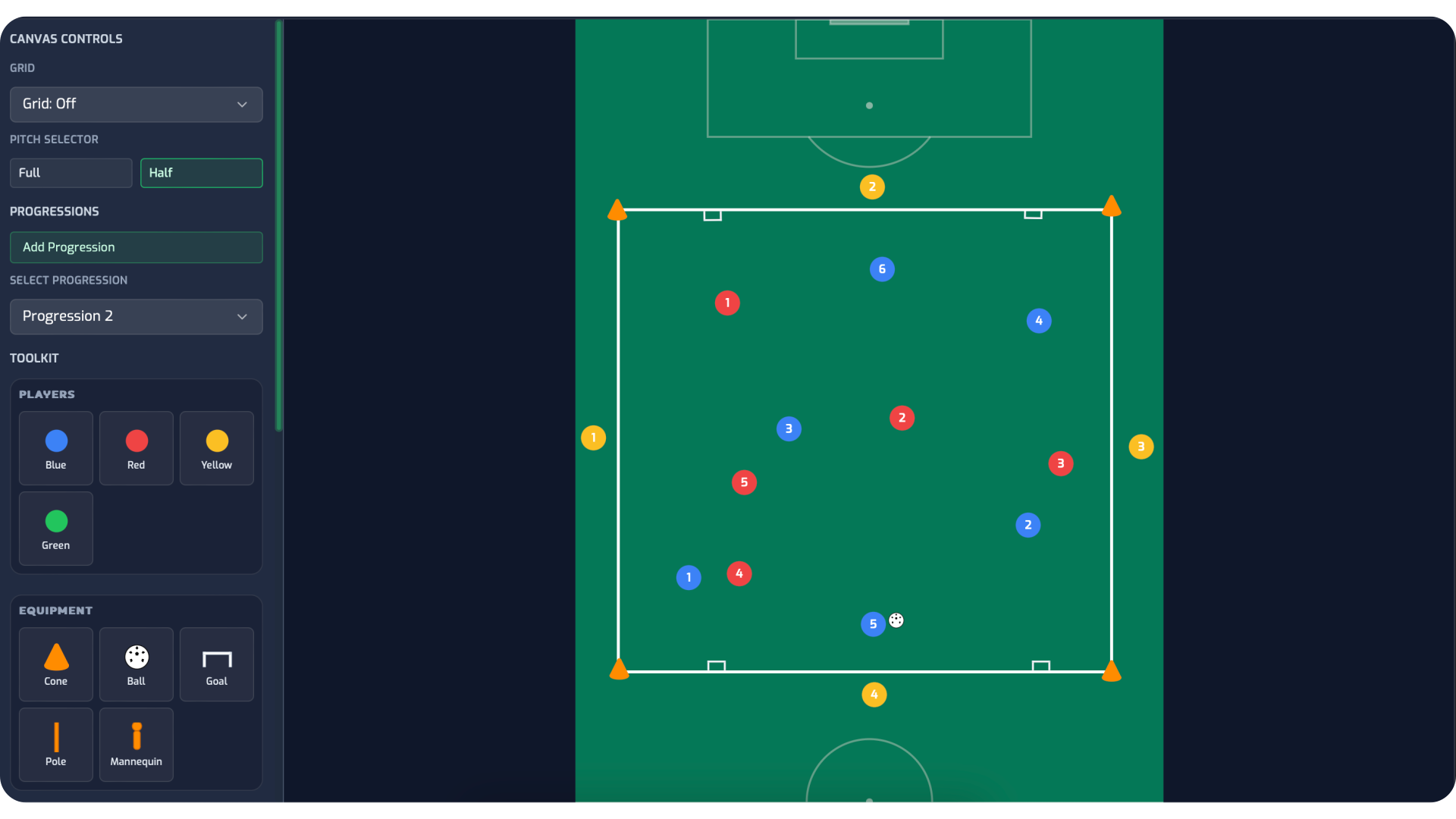
The most important shift in mindset for coaches who want to use small-sided games effectively is understanding that the rules of the game are the primary coaching tool, not what you shout from the sideline.
In a traditional drill, the coach delivers the instruction and the players execute. In a well-designed small-sided game, the constraint built into the rules produces the learning outcome, and the players discover the solution themselves. A player who discovers that opening up their body to receive produces more passing options will retain that learning more durably than a player who was told to open up their body and complied without fully understanding why.
This principle is sometimes called constraint-led coaching, and it is the foundation of how the best youth development environments in the world design their training. The coach's job is not to explain the answer. It is to design an environment where players are likely to find it.
In practice, this means every small-sided game you design should have one rule that creates the condition for your coaching objective to emerge naturally. If the objective is combination play, a rule that requires two passes before a shot forces players to combine. If the objective is defensive compactness, a rule that scores bonus goals when the team defends as a unit within a defined zone creates the right defensive behaviour without the coach needing to instruct it constantly.
CoachTactiQ's Training Hub allows coaches to build small-sided game formats directly in the drill designer, including the pitch dimensions, player numbers, rules and coaching notes for each game. Those formats can be saved with their progressions and reused across sessions, building a library of SSG designs that evolve as your players develop.
The shift from a training structure built around drills with a game at the end to one built around game-based learning with targeted technical work is not complicated, but it does require a deliberate change in how sessions are planned and what gets prioritised.
Start by extending the game time in your sessions and reducing the time spent in static drills. Design the rules of your small-sided games before you arrive at training so the constraint is clear and connected to your objective. Resist the instinct to over-coach during the game. Observe, ask questions at natural breaks and let players find solutions.
Over time, building a library of small-sided game formats tied to specific development objectives makes session planning faster and more consistent. CoachTactiQ's Training Hub is built for exactly this, giving coaches the tools to design, save and progressively develop their SSG library as part of a complete coaching workflow. Try it free for 30 days at coachtactiq.com.