
There is no shortage of coaching courses, tactical frameworks or content promising to make you a better football coach. And while education matters, what actually separates consistently effective coaches from the rest is rarely knowledge alone. It is behaviour. The daily and weekly habits that compound quietly over a season, over a career, into something players remember long after the final whistle.
These five football coaching tips show up consistently in coaches who develop players well, retain squads, earn respect and keep improving regardless of the level they work at.
Effective coaches do not arrive at training with a loose idea and hope for the best. Every session has one primary objective - a specific skill, decision or tactical concept that every activity in that session serves. Not two objectives. Not three. One.
This matters because it forces clarity. When you know exactly what you are trying to develop in a given session, every coaching intervention becomes more purposeful. Your questions to players are sharper. Your progressions make sense. Players leave having genuinely worked on something rather than moving through a series of disconnected activities.
There is a significant difference between a session that is themed and one that is purposeful. A themed session might focus on finishing because there is a big game coming up. A purposeful session asks a more specific question: are we developing finishing from wide positions under defensive pressure, or clinical finishing in one-on-one situations? That level of specificity shapes the design of every activity in the session and produces more targeted development over time.
One of the most common coaching instincts is to intervene quickly. A player makes a poor decision and the coach steps in immediately to correct it. The intention is good. The timing is often not.
Effective coaches develop the habit of observing first. They allow a pattern to emerge before they stop the session. They ask themselves whether what they are seeing is isolated or consistent, whether it is a technical issue or a decision-making one and whether the player is close to solving it themselves. That discipline produces more meaningful interventions and gives players more opportunity to problem-solve without being rescued.
There is a concept in coaching science called the discovery learning approach, which holds that players who find solutions themselves retain those solutions more durably than players who are simply given the answer. A coach who freezes the session every ninety seconds is not developing independent decision-makers. They are creating players who wait to be told what to do, which is precisely the opposite of what is needed in a match when the coach cannot intervene at all.
Feedback is one of the most studied areas of coaching science and one of the most consistently misapplied in practice. Effective coaches understand that feedback is only useful if the player receiving it knows what to do differently.
Vague feedback such as "work harder", "think faster" or "be more confident" gives players nothing concrete to act on. Specific, actionable feedback tied to a real moment does. "When you received the ball in that position, your body shape only allowed you to play forward. Open up earlier and you create two more options" is feedback a player can apply immediately in the next repetition.
Timing matters as much as content. Feedback delivered immediately after a moment of failure, while the player is still processing what happened, is absorbed differently to feedback delivered during a pause in play when the player has had a moment to reflect. Neither is always better. The effective coach reads the player and chooses the moment accordingly.
Memory is unreliable. Research in cognitive psychology consistently shows that people recall emotionally salient events more vividly than routine ones. In a coaching context, this means a coach's recollection of a game is disproportionately shaped by the goal that was conceded or the miss that cost the team the win, rather than the thirty minutes of good defensive shape that preceded it.
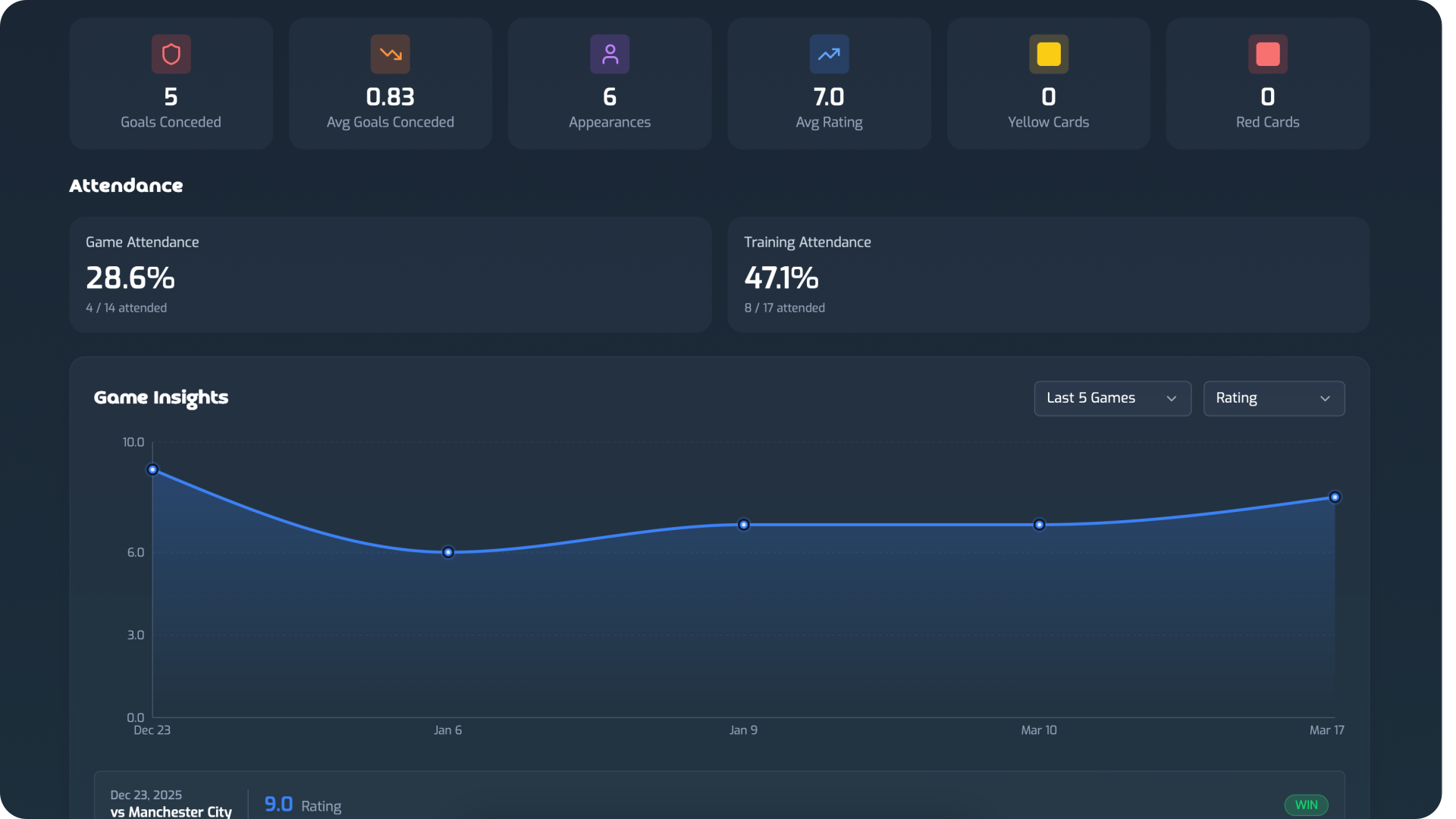
Training sessions built on that distorted memory address what felt significant rather than what the data actually shows.Systematic post-game review also changes the quality of conversations with players. When a coach can point to specific data, a player's rating across five consecutive games, their contributions relative to their position or the team's record when a particular player starts, those conversations become grounded in evidence rather than opinion. Players respond better to objective data than to a coach's subjective impressions, particularly when the feedback is corrective.
At grassroots level, systematic data collection has historically been difficult. That has changed. CoachTactiQ's Game Hub allows you to track live game events including goals, assists, cards, substitutions and timestamped notes during the match. You can rate individual player performances after the game and review how results have trended across the season. That data feeds directly into the Insight Hub, where you can visualise over 100 data points, compare players head to head and access IQ Insights, which surfaces relevant patterns and recommendations based on your team's actual performance data.
This is arguably the hardest habit to build, particularly at grassroots level where wins and losses are visible and pressure from parents, clubs and the coaches themselves can be significant. Effective coaches maintain a clear distinction between what the scoreboard says and what the players are actually developing.
A team that wins 4-0 by playing long balls to a physically dominant striker has not necessarily had a better developmental outcome than a team that loses 2-1 while executing a specific pressing trigger with genuine understanding for the first time. The result and the development are different measurements. The best coaches track both and weight them appropriately for the age and stage of their players.
This distinction becomes especially important as players move through the age groups. Coaches who chase results at junior level often do so by favouring physical maturity over footballing intelligence, limiting the development of technically gifted but late-developing players. The research on relative age effect in football is well-established: players born earlier in the selection year are consistently overrepresented at elite academies, not because they are more talented but because they are physically ahead of their peers at the age when selection decisions are made. A coach focused purely on winning reinforces this dynamic. A coach focused on development challenges it.